Five hosted APIs that return YouTube transcripts, priced at the volumes people actually run: 10,000 to one million requests a month, checked August 4, 2026.
The five APIs at a glance
| API | Best for | What you get |
|---|---|---|
| API1. Tapline | Best forProduction YouTube workloads | What you get500,000 transcript requests for $199, plus eleven YouTube endpoints on one key |
| API2. Supadata | Best forMulti-platform media data | What you getYouTube, TikTok, Instagram, and Facebook data through one developer API |
| API3. ScrapeCreators | Best forFlexible prepaid usage | What you getCredits never expire, cache hits are free, and one account covers 20+ platforms |
| API4. TranscriptAPI | Best forA low-cost starting plan | What you get$5 includes 1,000 requests plus search, channel, playlist, and MCP access |
| API5. Apify | Best forCustomizable actor workflows | What you getA ready-made YouTube actor with UI, API, webhook, and integration options |
1. Tapline: best overall for production YouTube APIs
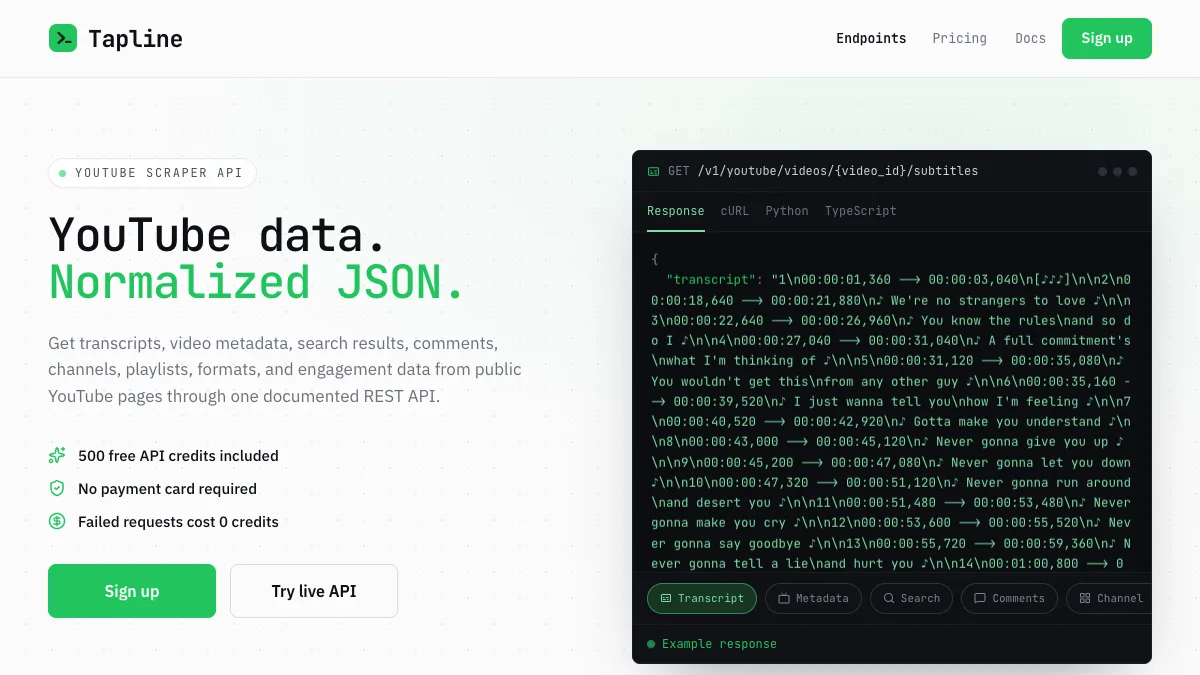
Tapline ranks first here. The $199 Growth plan covers 500,000 transcript requests, or $0.40 per 1,000 at full use. Pro costs $499 for two million requests, which brings that down to $0.25 per 1,000.
Most transcript projects eventually need other YouTube data. Tapline uses the same key for transcripts, metadata, search, channels, channel videos, playlists, comments, comment replies, formats, subtitle tracks, and the most-replayed heatmap.
- 500,000 transcript requests on Growth and two million on Pro
- Eleven YouTube endpoints under one key and credit pool
Explore the Tapline YouTube API or jump straight to the endpoint documentation.
One caveat: no AI fallback. A video with captions disabled has nothing to fetch.
2. Supadata: best for data from several social platforms
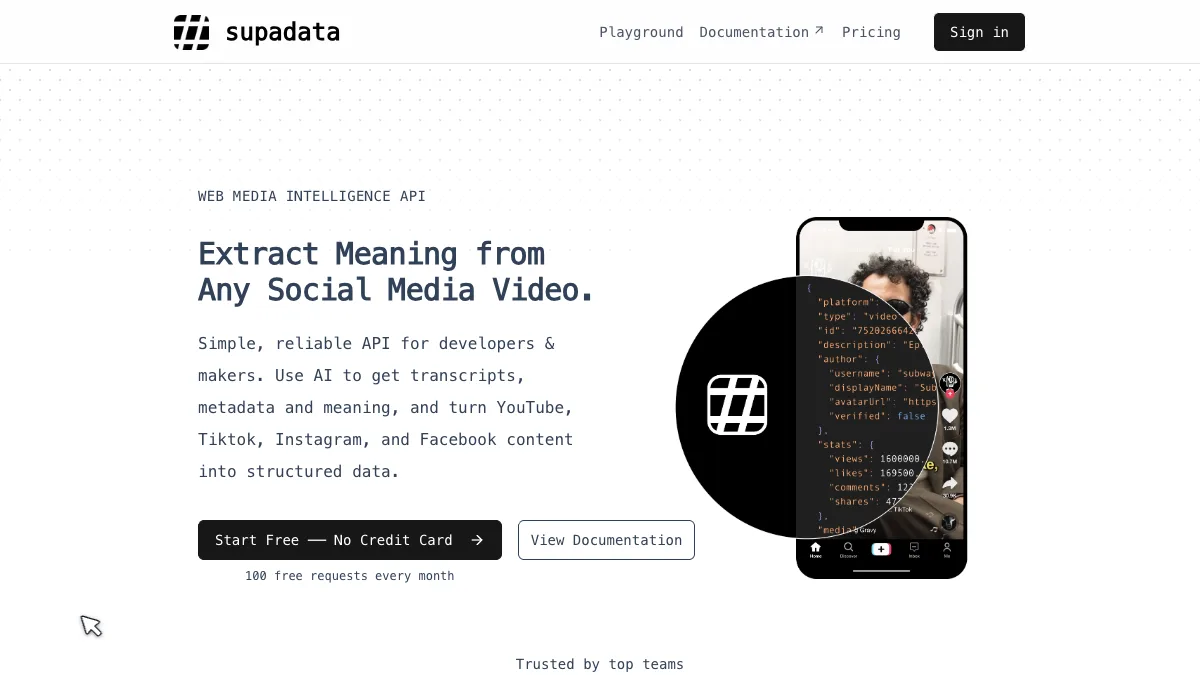
Supadata covers YouTube, TikTok, Instagram, and Facebook through one API. It returns transcripts and metadata, and its media-intelligence endpoints can analyze the content as well. This keeps a multi-platform project under one account and one response format.
- Multi-platform coverage through one developer API
- Transcript, metadata, and media-intelligence features
- A $5 entry plan and a browser playground for quick evaluation
Visit Supadata or read our Supadata and Tapline guide.
Caveat: one credit pool covers all of Supadata's platforms, so other jobs draw down the same balance.
3. ScrapeCreators: best for prepaid credits
ScrapeCreators sells prepaid credits that never expire. Cached results are free, and the service advertises no rate limit. That pricing works well for occasional collection jobs because any unused balance stays available for the next run.
- Prepaid credits that never expire
- Free cached results and no advertised rate limit
Caveat: pricing is prepaid, so the totals here depend on the combination of packs used to cover the workload.
4. TranscriptAPI: best low-cost starting plan
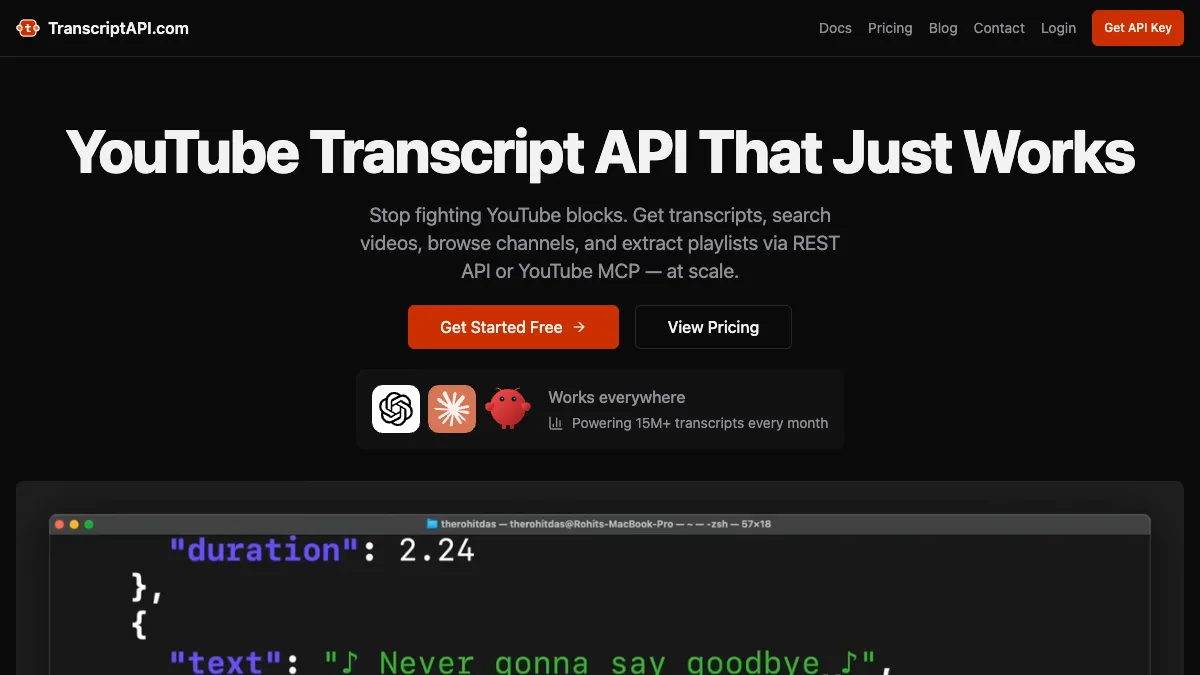
TranscriptAPI starts at $5 for 1,000 requests, the cheapest paid entry point on this list. The plan also includes video search, channel and playlist videos, and a YouTube MCP server for agent workflows.
- 1,000 monthly requests for $5
- Search, channel, playlist, REST API, and MCP access
Caveat: past the included volume, top-ups run $2.50 per 1,000, the highest rate here at scale.
5. Apify: best for customizable actor workflows
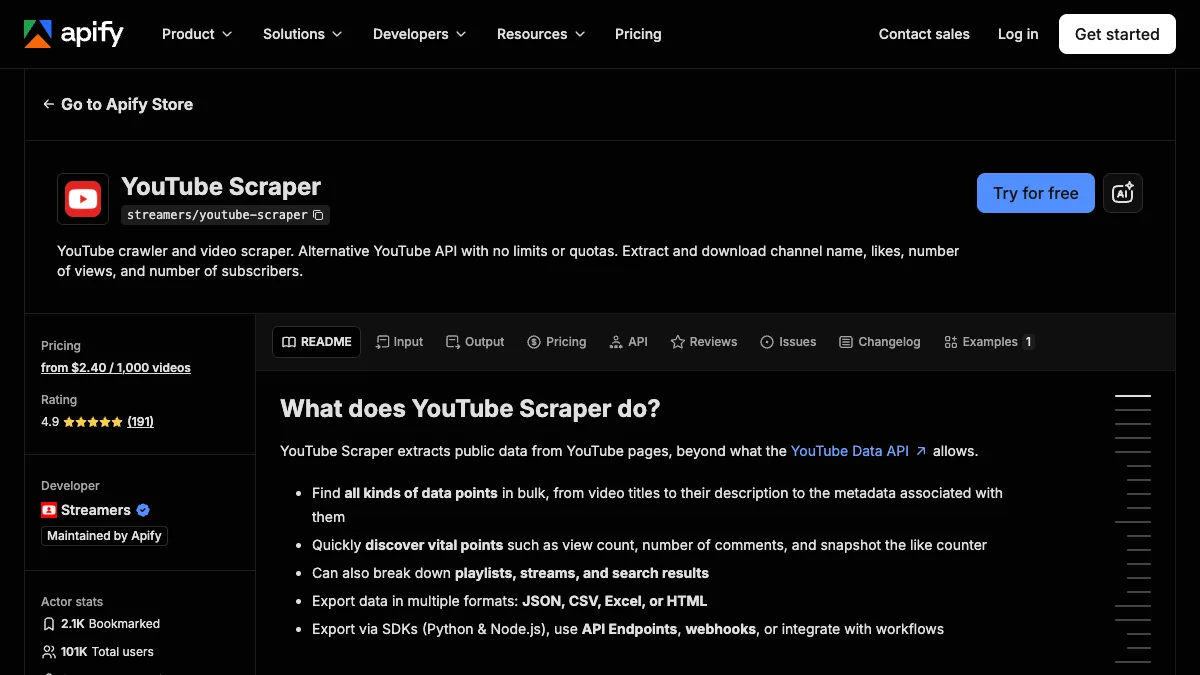
Apify's YouTube Scraper accepts URLs or search terms through a visual console or JSON input. You can run it from the console, call it over the API, or send results to another service with webhooks and integrations.
- A ready-made actor with a visual input form and API access
- Search-term, URL, Shorts, stream, playlist, and channel workflows
Visit the Apify YouTube Scraper or see our Apify and Tapline guide.
Caveat: actor pricing varies per result and per actor, so these totals move if you switch actors.
Pricing at a glance
The table compares the lowest published monthly plan or prepaid spend for the same number of transcript requests. It does not include annual discounts.
| Option | 10,000 | 100,000 | 500,000 | 1 million |
|---|---|---|---|---|
| OptionTapline | 10,000$49 | 100,000$199 | 500,000$199 | 1 million$499 |
| OptionSupadata | 10,000$47 | 100,000$297 | 500,000$897 | 1 million$897 |
| OptionScrapeCreators | 10,000$47 | 100,000$188 | 500,000$497 | 1 million$994 |
| OptionTranscriptAPI | 10,000$27.50 | 100,000$252.50 | 500,000$1,252.50 | 1 million$2,502.50 |
| OptionApify streamers actor | 10,000from $24 | 100,000from $240 | 500,000from $1,200 | 1 millionfrom $2,400 |
TranscriptAPI has the lowest listed bill at 10,000 requests, and ScrapeCreators reaches $188 at 100,000. Tapline costs $199 at 500,000 requests. At one million, its $499 Pro plan still has another million requests left in the allowance.
What about the official YouTube Data API?
Google's API is official and free within quota. It covers metadata, channels, playlists, comments, and write operations. captions.download requires permission to edit the video, so products that need transcripts from public videos generally use a hosted API as well.
Our YouTube Data API and Tapline guide shows how the two fit together.
If you run the free youtube-transcript-api library and it keeps getting blocked, we compare that route against a hosted API too.
Method and sources
We reviewed the public product pages, pricing, and documentation for Tapline, Supadata, ScrapeCreators, TranscriptAPI, and the Apify streamers actor. Pricing uses the cheapest listed monthly plan or stack of prepaid packs that covers each workload, with annual discounts excluded.
Tapline publishes this page and ranks its own product first. Product screenshots and public pricing were checked August 4, 2026. Tapline is not affiliated with, endorsed by, or sponsored by YouTube or Google.
FAQ
A REST API that accepts a YouTube video ID or URL and returns the video's caption text as JSON, usually with a timestamp on each line. Hosted services handle retrieval, cloud IP reliability, rate limits, and billing. Google's own captions.download method only works when the caller has permission to edit the video.
Tapline ranks first in this guide. Its $199 Growth plan includes 500,000 transcript requests. The same account also covers comments, heatmaps, video formats, subtitle tracks, search, metadata, channels, and playlists.
Yes. Tapline, Supadata, ScrapeCreators, and TranscriptAPI include enough free requests to test the response with a small set of videos. Regular production use requires a paid plan.
Because the captions.download method requires permission to edit the video. For a video you do not own it returns 403 forbidden. No quota increase changes that, because it is a permissions boundary rather than a rate limit.
The rates in this guide run from $0.25 to about $2.75 per 1,000 transcript requests before annual discounts. TranscriptAPI costs $27.50 for 10,000 requests with monthly top-ups. Tapline costs $199 for up to 500,000 requests and $499 for up to two million.
All five hosted services in this comparison can be called from AWS Lambda. Your function calls the vendor rather than YouTube directly, so you do not have to maintain a separate proxy setup.
Tapline has the lowest listed price at 500,000 requests and publishes eleven YouTube endpoints under one key. Growth includes 500,000 transcript requests for $199. Pro includes two million for $499.
Tapline publishes the broadest documented set of YouTube-specific endpoints among the hosted transcript APIs compared here. Its eleven endpoints cover transcripts, video metadata, search, subtitle tracks, channel info, channel videos, playlists, comments, comment replies, video formats, and the engagement heatmap under one credit pool. Comments and replies are cursor-paginated, so a job can collect a whole comment section rather than the first page.
To try the response with your own video, use the free transcript tool or inspect every field in the YouTube API docs.